
In a high-volume hospitality environment, the difference between a signature espresso and a wasted shot often comes down to the geometry of your grind. For restaurant and hotel operators, choosing a grinder is a business decision. It’s the choice between flavor complexity and extraction consistency the two factors that define your brand’s coffee quality and your service speed.
Whether you are spec-ing out a boutique coffee station with precision gear like the Zwilling Enfinigy series or auditing your main service line, understanding how burr shape dictates particle distribution is critical for maintaining consistency across hundreds of daily covers. In this technical guide, we analyze the physics of grind heat, retention rates, and why the right burr geometry is the foundation of a profitable, high-standard espresso program.
Why Burr Geometry Matters in Commercial Espresso
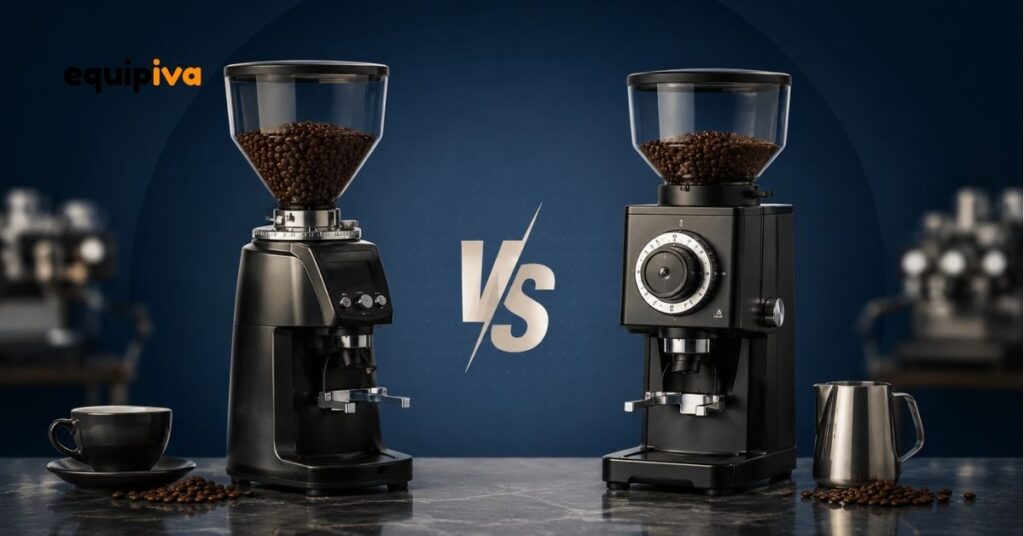
In a high-volume café, your grinder is the heartbeat of the bar. While many focus on motor speed, the true “expert” variable is burr geometry. The specific cut and angle of the teeth determine the particle size distribution, which directly dictates how water travels through the puck.
From an operational perspective, precision geometry is about extraction repeatability. When your burrs produce a uniform “sweet spot” rather than a chaotic mix of boulders and fines, your baristas aren’t constantly fighting the collar to fix a sour or bitter shot. This consistency stabilizes the café workflow, allowing the team to focus on hospitality rather than troubleshooting.
Moreover, superior burr design is a massive win for the bottom line. It cuts down those endless “dialing-in” sessions that eat up your morning, which honestly saves a massive amount of coffee and money over a few months. At the end of the day, it’s all about keeping your customers happy; the latte your regular grabs at 8:00 AM should hit exactly the same during the 2:00 PM rush. In a busy shop, burr geometry isn’t just some technical detail it’s your insurance policy for quality.
What Are Conical Burr Grinders?
A conical burr grinder is pretty much exactly what it sounds like: you’ve got one cone-shaped burr sitting inside a circular ring burr. Unlike flat burrs that use centrifugal force to spit grounds out the sides, a conical setup uses gravity to pull the beans straight down through the teeth. It’s a vertical path that’s efficient, stays cool, and handles a morning rush without breaking a sweat.
The Technical Side: RPM and Grind Behavior
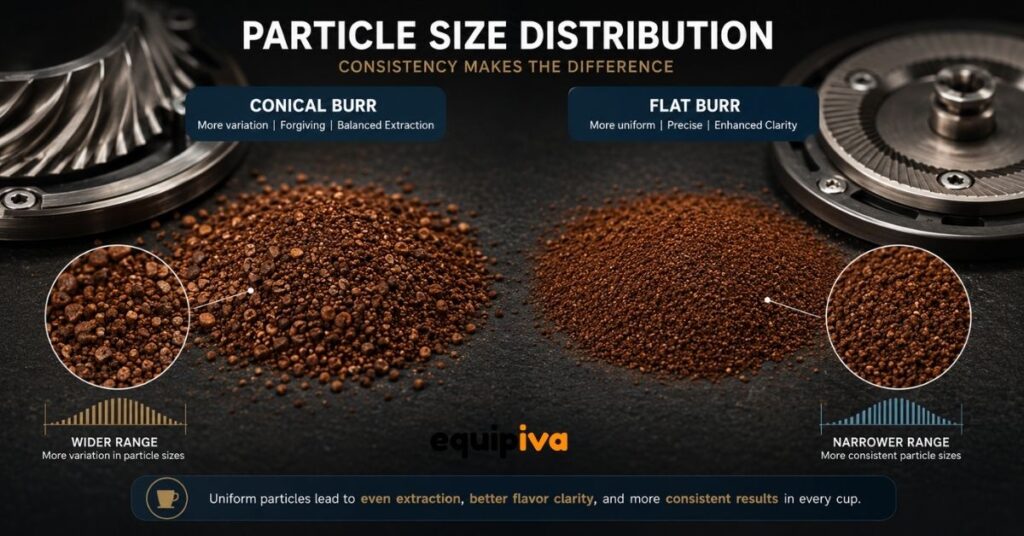
The big thing with conical sets is grind behavior. Because of the way the burrs intersect, they produce a “bimodal” distribution. In plain English, you’re getting two different sizes of coffee grounds in every basket. The tiny “fines” act like a filter to slow the water down and build pressure, while the larger grounds provide the flavor.
You’ll also notice these grinders run at a much lower RPM. Spinning the motor slower is a deliberate move to keep heat from building up on the steel. If your burrs get hot, they start “cooking” the coffee oils before you even pull the shot, which ruins the profile. Even in more streamlined home-pro units like the Zwilling 1010590 Enfinigy Coffee Bean Grinder, Black, the focus is on that low-friction, high-torque grind to keep the beans from getting scorched.
The Flavor Profile: Texture Over Everything
If you’re chasing a heavy, syrupy mouthfeel, conical is the way to go. Because of those mixed particle sizes, the extraction is a bit more “rugged.” It highlights the deep, chocolatey, and nutty notes that most Americans look for in a solid cup. While flat burrs are great for tasting one specific hint of blueberry in a light roast, conical burrs are built for that classic, rich espresso with a thick crema that actually holds up in a latte.
Why Hospitality Pros Use Them
In a busy café, you don’t always have time to geek out over every micro-adjustment. Conical grinders are famous for being forgiving. They have a wider “sweet spot,” meaning if the humidity in the shop shifts or your barista is slightly off on the dose, the shot is still going to taste great. It’s about operational reliability keeping the line moving during the 8:00 AM rush without having to dump five shots of sink-espresso just to get the grind back in line.
What Are Flat Burr Grinders?
When you step into a specialty shop focused on light roasts and single-origin beans, you’re likely looking at a flat burr grinder. The architecture here is totally different from a conical setup. Instead of a cone and a ring, you have two identical, donut-shaped discs sitting perfectly parallel to one another. One disc stays stationary while the other spins at high speeds, using centrifugal force to pull beans into the “teeth” and then out through the edges.
The Trade-off: Precision and Alignment Sensitivity
The biggest selling point of the parallel burr design is particle uniformity. Because the distance between the two discs is consistent across the entire grinding surface, these machines produce a “unimodal” grind. This means almost every single coffee particle is the exact same size. For a barista, this creates a predictable, even extraction where water flows through the puck at a constant rate, rather than finding paths of least resistance.
However, that precision comes with a catch: alignment sensitivity. If those two discs are off by even a fraction of a millimeter, the uniformity vanishes. Maintaining a flat burr grinder requires a more technical eye, as any slight tilt in the burr carrier can lead to uneven wear and “muddy” tasting shots. You also have to manage heat generation. Because these discs spin fast to create that centrifugal force, the friction can cause the burrs to heat up during heavy use, which requires a steady hand when adjusting the grind throughout a shift to maintain speed consistency.
Flavor Separation in Specialty Coffee
The reason the specialty coffee world puts up with the maintenance is the flavor separation. Because the grind is so uniform, you don’t get the “muddiness” associated with mixed particle sizes. Instead, you get a clean, tea-like clarity that allows you to taste specific notes think of it like high-definition audio for your palate. If a coffee is supposed to taste like jasmine and peach, a flat burr is the best tool to isolate those delicate acids without them being overshadowed by heavy, bitter oils.
Real-World Specialty Café Applications
In high-end specialty café applications, flat burrs are the gold standard for baristas chasing the “perfect” shot. They allow for higher extraction yields, meaning you can pull more flavor out of less coffee. But it’s not a universal win; while they excel at clarity, they often lack the thick, syrupy body that many traditional espresso drinkers love. In a shop that prioritizes technical brewing and complex flavor profiles, the flat burr provides the surgical accuracy needed to make those unique beans shine, provided the staff is ready to handle the extra upkeep.
Particle Distribution Explained
When you’re behind the bar, “particle distribution” is basically the blueprint of your espresso. It’s a fancy way of describing the range of sizes your grinder produces in a single dose. No grinder no matter how expensive spits out perfectly identical pieces of coffee. Instead, you get a mix, and how that mix is distributed determines whether your shot is a masterpiece or a drain-pour.
The Role of Fines and Boulders
In any given basket, you’re looking at two main characters: fines and boulders.
- Fines are the microscopic dust particles produced during the grinding process. They are essential because they act as the “glue” or the “plug” in the puck. They migrate to the bottom of the basket and restrict water flow, creating the necessary back-pressure to generate those 9 bars of force. Without fines, the water would just gush through. However, too many fines will clog the filter, leading to an over-extracted, bitter mess.
- Boulders are the larger, more uniform fragments. These provide the structure of the puck and allow the water to actually pass through. If your distribution is too heavy on boulders, the water moves too fast, resulting in an under-extracted, sour shot that lacks any real depth.
Extraction Curves and Channeling
The goal is to manage the extraction curves of all these different sizes simultaneously. Because smaller particles have more surface area relative to their volume, they extract almost instantly. Boulders take much longer.
If your particle distribution is too wide (meaning a chaotic mix of huge chunks and tiny dust), you hit a major roadblock: channeling. Water is lazy; it wants the path of least resistance. If the puck isn’t uniform, water will find a gap, blast through it, and leave the rest of the coffee dry. You end up with a shot that is somehow both sour (from the dry spots) and bitter (from the over-blasted channel).
Measuring Success: TDS and Crema Structure
In the modern “science-forward” café, we use TDS (Total Dissolved Solids) to measure how well our particle distribution is working. A high TDS usually means your grinder is hitting a sweet spot where enough solids are being dissolved to create a rich, full-bodied drink.
This also directly impacts your crema structure. The crema is an emulsion of CO2 and coffee oils. A good distribution of fines helps stabilize these bubbles. If your distribution is off, your crema will either be thin and dissipate quickly or be overly dark and “ashy.”
Comparison: Conical vs. Flat Distribution
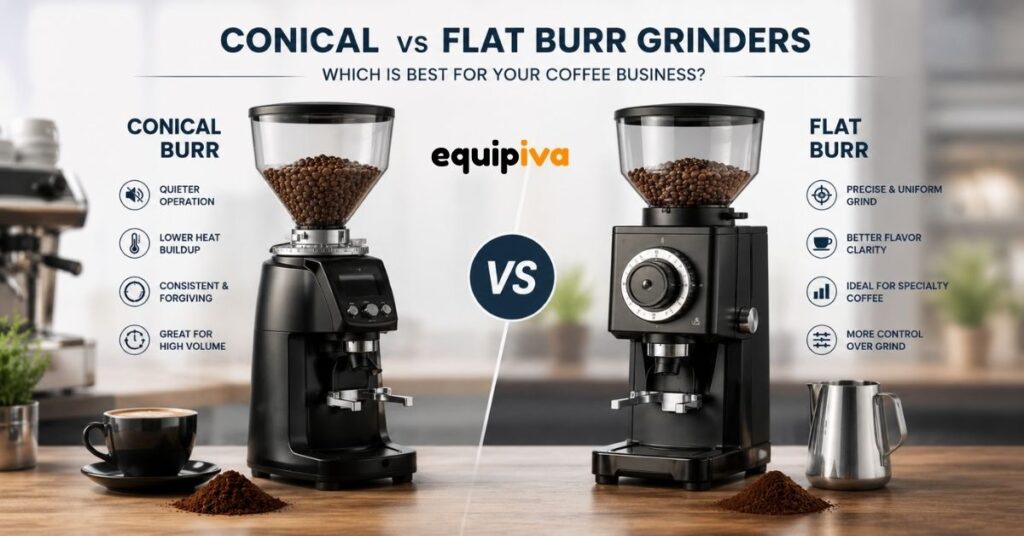
Understanding which grinder to use depends on what kind of distribution curve you want to achieve.
| Feature | Conical Burrs (Bimodal) | Flat Burrs (Unimodal) |
| Distribution Style | Two distinct peaks (fines + boulders). | One central peak (highly uniform). |
| Flow Resistance | High (fines provide easy pressure). | Lower (requires finer settings for pressure). |
| Mouthfeel | Syrupy, heavy, and textured. | Clean, silky, and tea-like. |
| Flavor Profile | Complex, blended, traditional. | Transparent, acidic, “high-definition.” |
| Forgiveness | High-easy to dial in. | Low-requires precision and maintenance. |
Why Grind Consistency Matters in Espresso
Look, if you’re running a shop, you know the “morning from hell” where the shots start running like water for no reason and your head barista is panicking at the collar. That’s why grind consistency is the only metric that actually matters when the doors open. If your grinder can’t hold a setting, you aren’t running a business you’re just guessing.
Survival During the Breakfast Rush
When you’ve got a line out the door at 8:00 AM, service speed is your lifeblood. You can’t have your team stopping every four drinks to re-dial the espresso because the burrs drifted. In a high-volume breakfast rush, you need shot repeatability. That means the shot pulled at 7:05 AM needs to hit the exact same numbers as the one at 9:15 AM.
Cheap grinders or worn-out burrs suffer from calibration drift. As they grind pound after pound, the friction heats up the metal, the burrs expand, and suddenly your 30-second honey-like espresso is a 15-second sour mess. A consistent commercial grinder handles that heat so your staff can actually focus on the customers instead of fighting the equipment.
The Reality of Multi-Barista Environments
In places like hotel cafés or busy retail spots, you usually have different people rotating on the machine. This is where labor consistency becomes a nightmare if the gear isn’t stable. If the grinder is finicky, one barista might be “fixing” it one way, while the next person does the opposite.
You also have to look at dose accuracy. If your grind size is jumping all over the place, the coffee density changes. Your “timed” dose might give you 18 grams one minute and 20 grams the next just because the grinds are fluffier or coarser. That 2-gram swing ruins the recipe and wastes expensive beans.
Why It Hits Your Wallet
At the end of the day, an inconsistent grinder is a money pit. Every “sink-shot” you dump because the grind drifted is pure profit going down the drain. In a multi-barista environment, you want the equipment to be the “anchor.” When the grind stays put, your service speed stays high, your waste stays low, and the coffee actually tastes like it’s supposed to. It’s about making sure the 50th latte of the morning is just as good as the first one.
| # | Product | Rating | Price | |
|---|---|---|---|---|
| 1 | 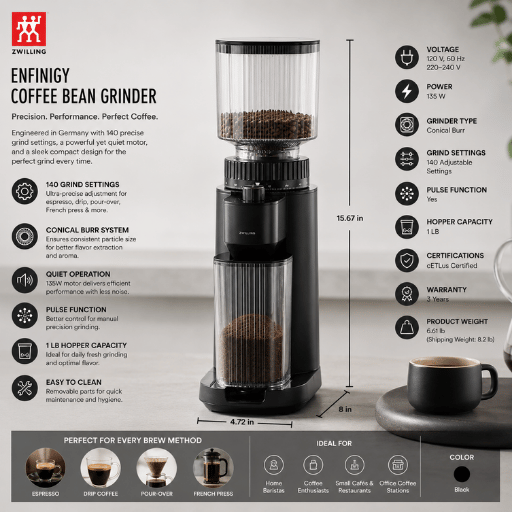 |
Zwilling 1010590 Enfinigy Coffee Bean Grinder, Black#1 Pick | ★★★★★5.0 | Check Price |
Heat Retention and Flavor Stability
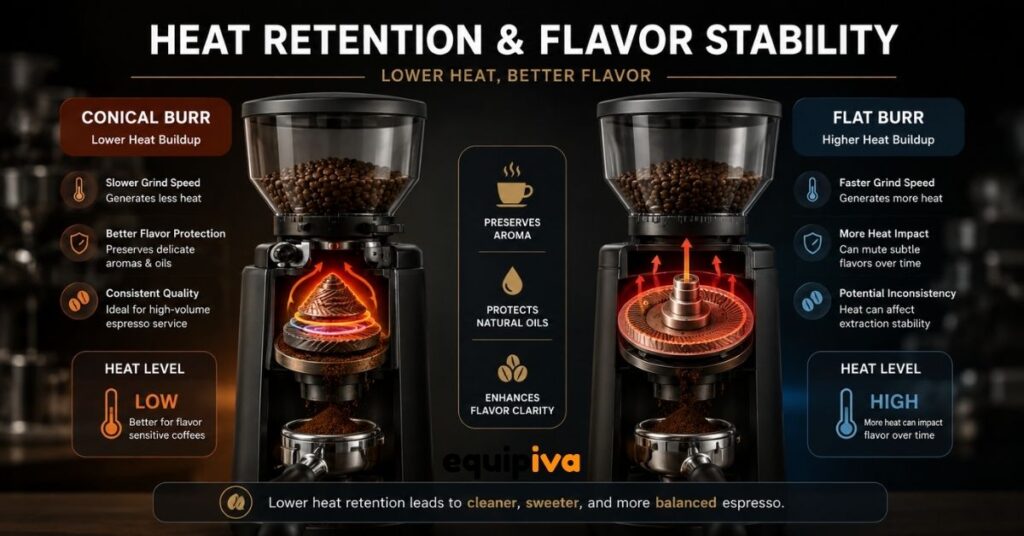
Think of heat as the silent killer of good coffee. When you’re slamming through a rush, your grinder’s motor and those spinning plates are creating a ton of burr friction. In continuous service conditions, that metal gets hot fast. If your grinder isn’t built to shed that energy, all that heat dumps directly into the beans, and that’s where things go sideways.
The Loss of Volatile Compounds
Coffee is full of volatile compounds those delicate oils and gases that make a specific roast taste like citrus or chocolate rather than just “burnt bean.” These are super sensitive to temperature. If the burrs are screaming hot, they start “pre-cooking” those oils before the water even touches the puck.
This causes massive aroma loss. Instead of those smells blooming in the customer’s cup, they’re being toasted off inside the grind chamber and vented into the room. By the time the coffee hits the portafilter, it’s already gone flat. You’re losing the very “pop” and complexity you paid a premium for when you bought the beans.
Thermal Drift and Flavor Stability
Beyond just the taste, heat transfer messes with your workflow. Hotter grounds act differently; they extract faster and can make your shots run wild. This is why a shot might taste balanced at 7:00 AM but bitter and “ashy” by 10:00 AM once the machine is fully heat-soaked.
Higher-end commercial gear usually fights this with:
- Cooling Fans: Ticking on automatically to pull air across the motor.
- Massive Heat Sinks: Using heavy metal bodies to soak up and radiate heat away from the beans.
- Low RPMs: Spinning slower so the friction doesn’t build up as fast in the first place.
At the end of the day, flavor stability is about temperature control. If you want your espresso to taste the same during a quiet Tuesday as it does during a frantic Saturday morning, you need a grinder that keeps its cool. If the heat wins, your coffee loses its soul before the barista even pulls the lever.
Retention Rates and Coffee Waste
If you want to find the “hidden leak” in your café’s budget, look at your grinder’s chute. Grinder retention refers to the coffee grounds that get stuck in the internal nooks, crannies, and exit paths after the motor stops. While it might look like just a dusting of powder, it’s actually a major driver of both inconsistent quality and shrinking profit margins.
The Problem with Stale Coffee
When coffee sits inside the grinder between orders, it oxidizes almost instantly. If your grinder has 4 or 5 grams of retention, the first half of your next double shot isn’t fresh it’s stale coffee from the previous customer. This old coffee loses its sweetness and crema-producing CO2, leading to a flat, metallic-tasting espresso.
To fix this, baristas have to perform a “purge” grinding a small amount of coffee and throwing it away just to clear out the old stuff. This purge waste is the “tax” you pay for owning a high-retention grinder.
Realistic Operational Calculations
The cost implications of retention become staggering when you look at the annual numbers. Let’s run a typical scenario for a mid-sized shop:
- The Waste: Suppose your grinder retains 2 grams of coffee that must be purged before a fresh shot.
- Daily Volume: You serve 200 shots per day.
- Total Daily Loss: 2g × 200 = 400 grams of coffee wasted every single day.
- Monthly Loss: 400g × 30 days = 12 kilograms (approx. 26 lbs).
- Annual Loss: 144 kilograms (approx. 317 lbs).
If you’re paying $15 per pound for a high-quality specialty roast, that’s over $4,700 a year literally being swept into the trash. That is the price of a brand-new, top-of-the-line grinder every single year.
Choosing for Efficiency
In a high-volume environment, you want a “low-retention” or “zero-retention” design. These grinders use straight-through chutes and specialized bellows to ensure that what goes in actually comes out. Reducing your purge waste from 2 grams down to 0.5 grams doesn’t just make the coffee taste better; it effectively gives you a massive year-end bonus by keeping your inventory in the hopper and out of the bin. In the hospitality game, the most expensive coffee you buy is the coffee you never get to sell.
Workflow Speed in Commercial Environments
Look, when the line is hitting the door and your baristas are in the weeds, the last thing you need is a grinder that’s a pain to work with. In a real-shop environment, barista efficiency isn’t about how fast someone can move their hands it’s about how well the gear keeps up with the pace. If your grinder is a bottleneck, your whole service is dead in the water.
Getting the Morning Started: Dial-in Speed
The most stressful ten minutes of the day happen right before you open. Dial-in speed is a massive factor here. If your adjustment collar is stiff, vague, or jumps all over the place, your team is going to waste half a bag of beans just trying to find a decent shot. You want adjustment usability that feels intuitive. When a barista can make a micro-tweak and see the result immediately, they get the shop ready faster and with way less stress.
Keeping the Peace: Service Continuity
Once the rush starts, you need service continuity. You can’t have a machine that requires a 20-minute teardown every time a stray pebble or a bit of oily buildup causes a jam. Modern commercial units are finally being built for quick access meaning you can clear the chute or brush the burrs in a couple of minutes between waves.
Long cleaning intervals are a hidden profit killer. If a grinder gets “grumpy” and starts clumping or slowing down because it’s hard to clean, your service speed tanks. You want a machine that stays clean longer and doesn’t require a toolbox just to wipe down the internals.
The Bottom Line for Owners
If you’re the one signing the checks, remember that a “cheap” grinder usually costs more in labor. A machine that’s easy to use reduces barista burnout and cuts down on the mistakes that happen when people are rushed. Whether it’s a hands-free portafilter holder or a simple, clear display, those small wins save seconds on every single ticket. In a busy shop, those seconds add up to extra drinks sold and shorter wait times. Don’t buy a science project; buy a tool that’s built for the reality of a Saturday morning rush.
Conical vs. Flat Burrs — Side-by-Side Comparison
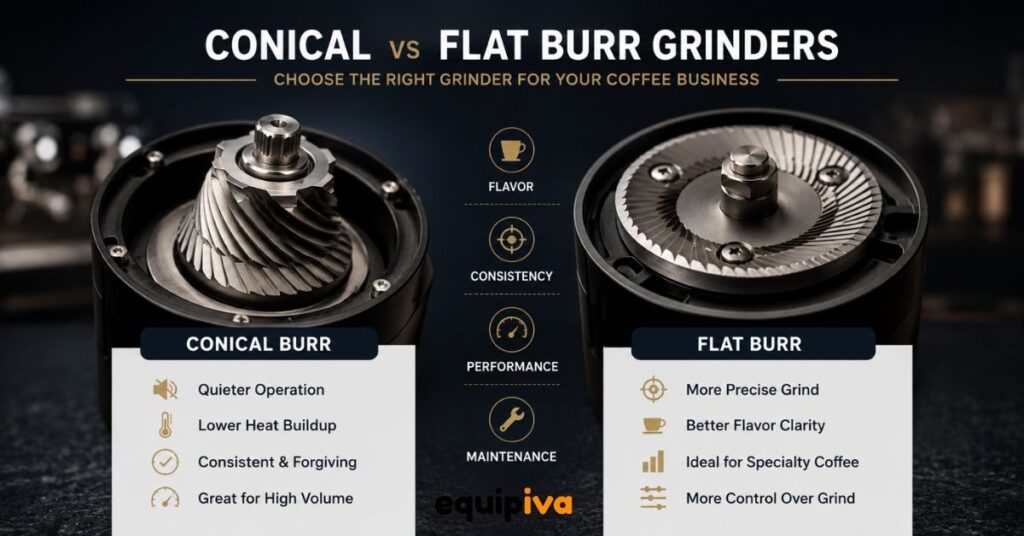
Choosing between conical and flat burrs usually comes down to your shop’s volume and the flavor profile you’re chasing. Conical burrs are the rugged workhorses they stay cool, handle rushes without a hitch, and produce a heavy, syrupy espresso that most traditional drinkers love. They’re forgiving to dial in, making them the “safe bet” for high-traffic environments where speed is king.
Flat burrs, on the other hand, are the precision tools of the specialty world. They offer incredible flavor clarity, allowing you to taste the distinct acidity in light roasts. However, they demand more attention. They run hotter, require constant micro-adjustments, and need a skilled hand to keep them aligned. If you want “perfect” shots and don’t mind the extra maintenance, go flat. If you want reliability and body, stay conical.
Comparison Table: At a Glance
| Feature | Conical Burrs | Flat Burrs |
| Flavor Profile | Traditional, chocolatey, heavy body | Modern, bright, high clarity |
| Shot Clarity | Blended and textured | Clean and well-separated |
| Heat Management | Excellent (runs cooler) | Moderate (prone to friction heat) |
| Retention | Usually lower (gravity-fed) | Higher (centrifugal force) |
| Noise Level | Generally quieter | High-pitched / Louder |
| Workflow | Forgiving; wide “sweet spot” | Demanding; requires precision |
| Best For | High-volume cafés & dark roasts | Specialty shops & light roasts |
Recommended Zwilling Enfinigy Coffee Grinders
If you’re looking for a piece of gear that bridges the gap between home-pro and light commercial use, the Zwilling Enfinigy line is usually where the conversation starts. They’ve moved away from the “appliance” feel and toward something that actually respects the chemistry of the bean. For a small bistro, a hotel lobby bar, or a high-end office, these grinders offer a level of German engineering that handles the daily grind without looking like a bulky industrial eyesore.
The Top Pick: Zwilling 1010590 Enfinigy Coffee Bean Grinder, Black
This is the flagship for a reason. Most grinders in this price bracket cheat by using high-speed blades or low-quality flat burrs that scorch the beans. The Zwilling 1010590 Enfinigy Coffee Bean Grinder uses a high-grade stainless steel conical burr set. As we’ve talked about, that conical shape is the secret to getting that thick, syrupy crema that customers actually want.
What makes this specific model stand out in a workflow is the low heat generation. Zwilling geared the motor to provide high torque at a lower RPM. This means you aren’t “pre-cooking” your coffee oils during a back-to-back rush. The static-reducing tech in the chute is also a lifesaver; there’s nothing worse than a messy counter in a clean hospitality environment, and this unit keeps the grounds in the bin rather than all over your workspace.
Key Features for Commercial Buyers:
- 12-Grind Settings: It’s versatile enough to switch from a coarse cold brew to a fine espresso without a headache.
- Pulse Function: Perfect for when you need just a tiny bit more coffee to hit that exact dose weight.
- Minimalist Interface: You don’t need a 50-page manual to train your staff. It’s intuitive turn the dial, hit the button, and go.
- Durable Housing: The black finish isn’t just for looks; it’s a rugged, easy-to-wipe surface that holds up to the spills and splashes of a busy service station.
Why It Fits Your Shop
The reason we recommend the Enfinigy line for light commercial applications is the consistency-to-cost ratio. You’re getting a professional-grade conical burr set that produces a reliable bimodal distribution. In a multi-barista environment, you need gear that doesn’t “drift” when it gets warm. These units are built to stay calibrated, so the shot you pull at 9:00 AM isn’t a completely different beast by 11:00 AM.
The Verdict
If you’re running a 200-seat high-volume café, you’ll eventually want a heavy industrial beast. But for boutique hotels, small restaurants, or premium office setups, the Zwilling 1010590 Enfinigy is a powerhouse. It’s quiet enough not to kill the atmosphere of a room, but tough enough to handle consistent orders. It’s an investment in flavor stability and workflow speed that won’t blow out your equipment budget. When you care about the “human” side of service keeping things clean, fast, and tasting great this is the tool that gets the job done.
Which Burr Type Is Better for Restaurants and Hotels?
In the hospitality world, the “best” equipment isn’t just about what produces the highest score on a cupping table it’s about what survives a Saturday night rush or a 7:00 AM breakfast surge. For restaurants and hotels, the choice between conical and flat burrs usually comes down to your staff’s skill level and the volume of coffee you’re moving.
Choose Conical If…
You need a grinder that is forgiving and rugged. Conical burrs are the gold standard for high-volume environments where “service continuity” is the priority. Because they produce a wider range of particle sizes, they have a massive sweet spot. This means even if your grind is a hair off, the espresso still tastes rich and syrupy.
This is the right choice for hotel lobby bars or busy restaurant service stations where you might have multiple servers or bartenders using the machine. You don’t want a grinder that requires a scientist to dial in every twenty minutes. Conical burrs run cooler, handle thermal expansion better, and produce that classic, heavy-bodied espresso that pairs perfectly with milk-based drinks like lattes and cappuccinos. If you want a “set it and forget it” workflow that keeps the line moving, go conical.
Choose Flat If…
Your brand is built on a specialty coffee experience. If you are running a high-end boutique hotel or a restaurant that prides itself on a curated, single-origin coffee program, flat burrs are the way to go. They offer the flavor clarity and “high-definition” acidity that modern coffee enthusiasts chase.
However, be prepared for the trade-off. Flat burrs are precision tools. They are sensitive to heat and alignment, meaning they require a dedicated barista who knows how to micro-adjust the settings as the day warms up. If your staff isn’t trained to “chase the grind,” a flat burr grinder can quickly become a source of frustration, leading to “muddy” or sour shots during a rush. Choose flat burrs if you have the labor talent to manage them and your menu focuses on light-roast, complex espresso.
The Bottom Line
For 90% of hospitality businesses, conical burrs are the smarter investment. They offer better “operational insurance” against human error and heat drift. While flat burrs can reach higher peaks of flavor perfection, conical burrs ensure that every guest gets a consistently great cup, regardless of how busy the bar gets or who is pulling the shot. In this industry, consistency isn’t just a goal it’s the backbone of your reputation.
Maintenance and Cleaning Best Practices
If you want your grinder to last five years instead of two, you have to treat it like any other precision kitchen tool. In a commercial setting, coffee oils are your biggest enemy. They turn rancid quickly, and if they build up on your burrs, every shot you pull will have a bitter, “off” aftertaste that no amount of dialing-in can fix.
Daily and Weekly Cleaning Intervals
For high-volume shops, a daily wipe-down isn’t enough. You need to manage retention by vacuuming out the chute and grind chamber at the end of every shift. This prevents old, oxidized grounds from contaminating the first batch of the next morning. On a weekly basis, use a specialized food-safe grinder cleaning tablet. These are designed to soak up the oily residue on the burrs without you having to take the whole machine apart.
Calibration Checks and Burr Lifespan
Even the best steel wears down. Burr lifespan depends on the material, but typically, commercial steel burrs should be replaced after grinding about 600–800 lbs of coffee. You’ll know they’re dulling when the “fines” increase and the motor sounds like it’s struggling.
To keep things running smooth, perform calibration checks every Monday morning. Check the “zero point” (where the burrs just start to touch) to ensure the adjustment collar hasn’t drifted due to vibrations or heavy use.
Why It Matters
A clean grinder doesn’t just taste better; it runs cooler and faster. When you stay on top of your cleaning intervals, you reduce friction, which prevents the heat spikes that ruin your flavor stability. In the hospitality game, a well-maintained grinder is your best defense against waste and inconsistent service. Take care of the steel, and the steel will take care of your margins.
Final Verdict
At the end of the day, there isn’t a “best” grinder there’s just the one that actually fits your morning rush. If you’re a specialty shop geeking out over light roasts and chasing that perfect, tea-like clarity, you’re going to want flat burrs. Just be ready for the extra maintenance and the constant micro-adjusting that comes with the territory.
But from an operational perspective, most shops need a workhorse, not a science project. Conical burrs are usually the smarter play for a busy restaurant or hotel bar. They’re forgiving, they don’t overheat the second things get busy, and they deliver that heavy, chocolatey espresso that your customers actually expect. It’s about making sure the drink tastes great even when your barista is three deep and moving fast.
That’s exactly why we point people toward something like the Zwilling 1010590 Enfinigy Coffee Bean Grinder. It’s built to handle that “middle ground” where you need pro-level grind quality and thermal stability, but you don’t want a machine that looks like a piece of industrial factory equipment. It’s sleek, it’s quiet, and it just works.
Ultimately, your choice should come down to your staff and your menu. If you want reliability and a “set it and forget it” workflow that keeps the line moving, go conical. If you want to push the absolute limits of flavor and have the time to baby the machine, go flat. Either way, the gear should serve your business, not the other way around.
Buying Guide
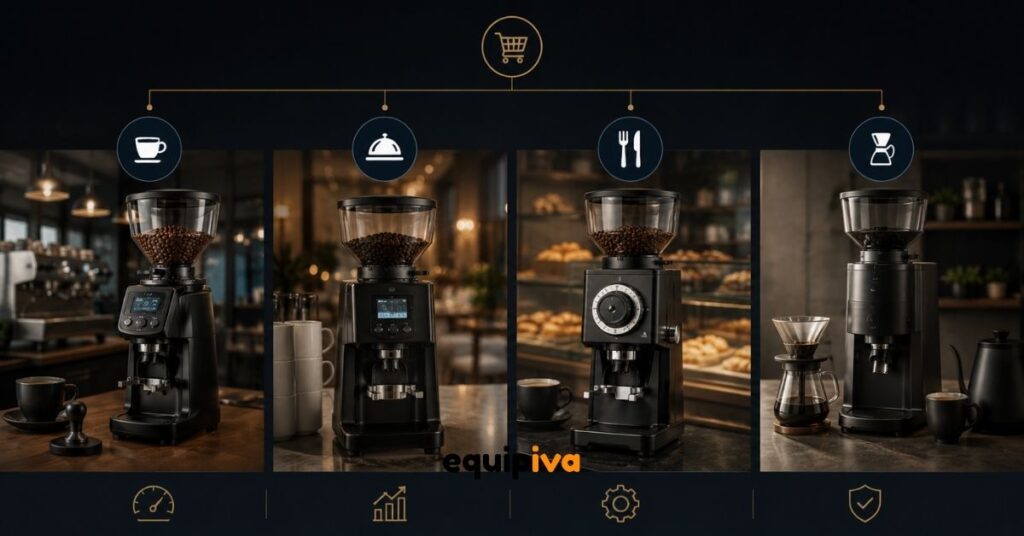
Choosing between a conical burr grinder and a flat burr grinder comes down to workflow, flavor goals, and commercial coffee volume. Conical burr grinders are known for consistent performance, lower heat buildup, quieter operation, and forgiving extraction, making them a strong fit for cafés, restaurants, and everyday espresso service.
Flat burr grinders deliver tighter particle distribution and greater flavor clarity, helping highlight nuanced tasting notes in specialty coffee programs. For high-volume commercial espresso setups, prioritize grind consistency, speed, retention control, burr durability, and easy maintenance. The right commercial coffee grinder should match your menu, daily output, and espresso quality standards—not just your budget.